
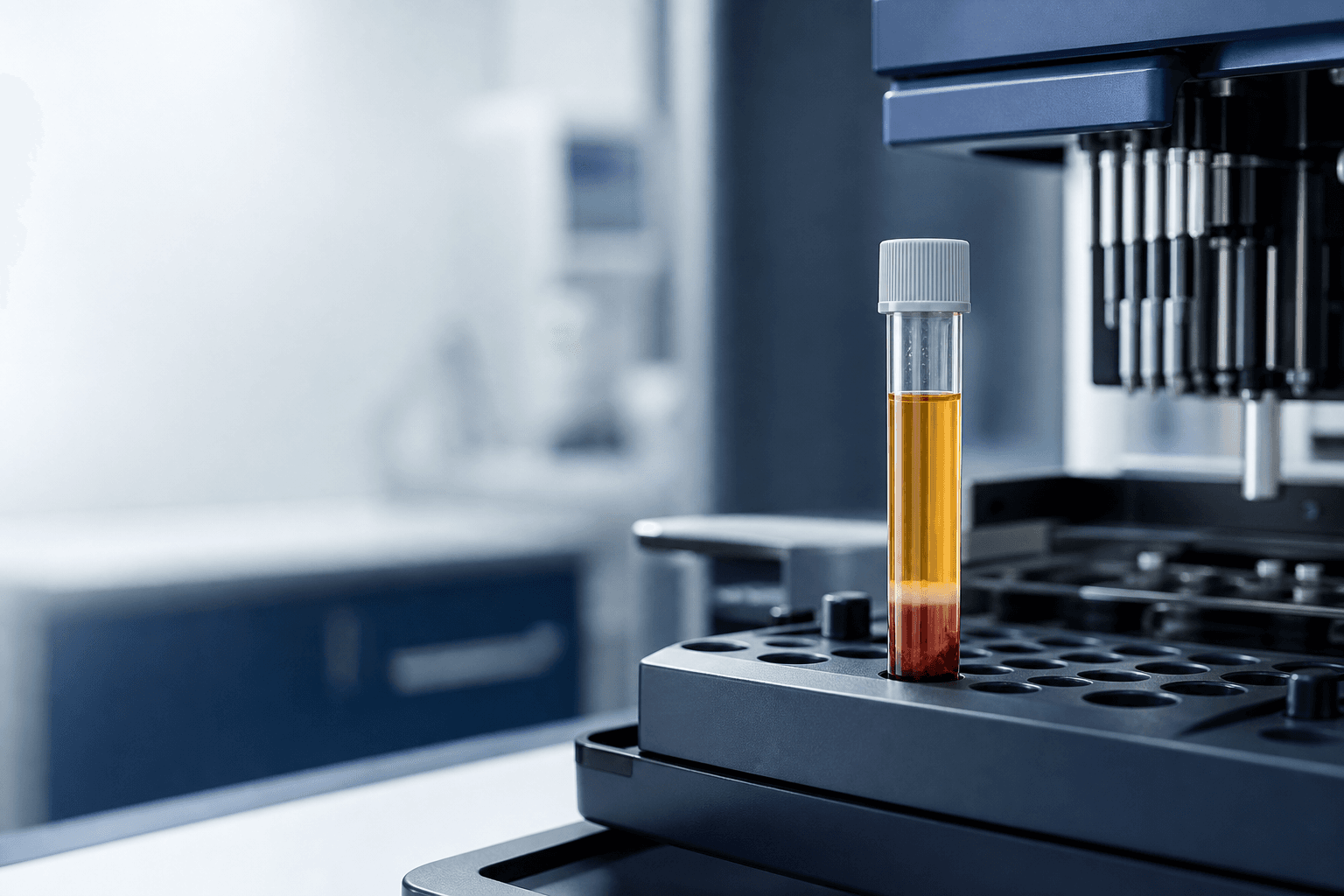
Designed for molecular monitoring after treatment.
VitaGuard MRD
One blood test can reveal a signal
while a series can show how it changes
VitaGuard is a functioning tumour-naive MRD workflow with commercial operating experience. Fidelion is developing international laboratory implementation around that foundation.
A fixed targeted panel avoids patient-specific assay development before testing can begin.
Plasma cell-free DNA enables a series of molecular snapshots.
What tumour-naive means
Begin with blood
and remove the tissue-dependent first step
Some MRD approaches first sequence a patient’s tumour and use what they find to develop a patient-specific assay. VitaGuard instead uses a fixed targeted panel designed to begin from a blood sample.
This removes a tissue-dependent first step, supports a consistent repeat workflow and may make testing more practical when tumour tissue is unavailable, insufficient or difficult to access. Tumour-naive and tumour-informed approaches have different strengths; performance and intended use must be established for each setting.
Two paths to molecular follow-up
The same clinical question
with a different starting point
Tumour tissue → sequence tumour → develop a patient-specific assay → monitor blood
Blood sample → apply a fixed panel → classify and follow the signal
Designed for a consistent repeat workflowWhat time can add
Presence and quantity matter
Direction adds the story
PresenceWhether ctDNA is detected under defined reporting rules.
QuantityMeasures used to describe the reported molecular signal.
DirectionWhether the signal appears, clears, persists, rises or falls across repeat samples.
Protecting the signal
The signal can be lost
long before the result
Finding low levels of tumour-derived DNA depends on every step—from collection and recovery to molecular tagging, sequencing, error suppression and interpretation.
Collect
Begin with blood and separate plasma under controlled conditions.
Protect
Recover scarce cell-free DNA and prepare selected target regions.
Read
Sequence targeted regions and apply the defined analytical workflow.
Follow
Report ctDNA status, quantity and change across available time points.
Inside VitaGuard
Built to protect
a scarce signal
VitaGuard brings sample handling, molecular identity, targeted sequencing and interpretation into one connected workflow.
A fixed panel without the need to create a patient-specific assay from each patient’s tumour.
Collection, separation, extraction and library preparation all influence a scarce signal.
The defined workflow is designed to identify and follow low-abundance candidate signals.
Fidelion is building the evidence, quality and regulatory pathways required for responsible expansion.
The larger opportunity
Every timepoint can add another layer of context
With appropriate consent, data rights and clinical annotation, repeat testing may support better reporting, research and future analytical tools.
Product status
Commercial experience provides the foundation for trust in new markets
VitaGuard originated as a commercially used laboratory-developed test (LDT) workflow. International rights outside Greater China have been assigned to Fidelion; operational implementation remains in progress. Fidelion’s model is laboratory-delivered testing, not direct-to-consumer or general product sales. Availability in any new market remains subject to laboratory validation, quality requirements and applicable regulatory pathways.
Explore the evidence →